Uzanne, Octave
Canaletto - Bellotto
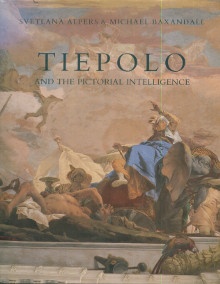
Tiepolo and the Pictorial Intelligence
Svetlana Alpers et Michael Baxandall
Yale University Press, New Haven and London, 1994.
In-4, reliure pleine toile éditeur sous jaquette illustrée en couleur, titre doré sur le dos, ix-185 pp.
Avec 170 illustrations en noir et en couleur.
Bon état d'ensemble. Quelques frottements sur les bords de la jaquette.
Chronology - I. A Taste for Tiepolo : Declining taste. - The painting. - The painter. - The painting in view. - Performing Veronese. - Dogs, clouds, poles as devices. - Discovery as a pictorial theme. - Para-narrative. - The music of the Moses. - Incantesimo - II. Intruments of Invention : Drawing, Paint, Light : Drawing. - Pen and wash. - Movement of the hand. - Line and the edges of known objects. - Generating the phenomenal. - Summary :graphic process and visual process. - Paint : the oil sketches. - Hue as a timbre : colour as light. - towards frescoes - shadow : Cochin on Tiepolo. - the mobility of lighting. - Negociations with site lighting. - the stimulus of mobile light - III. The Treppenhaus at Würzburg : The site : Balthasar Neumann's light theatre : sources and surface. - Perambulation : negociating with the windows. - The Figures. - the critique of rotational symmetry. - meanings and dimensions. - Groups : propagation from the oil sketch. - Rococo Syntax : a maze not without a plan. - drawing, scale and self-similarity. - the rococo lever : objects v. fields. - the taste of Europe. - the problem of Europe. - bracketing the moral - Appendix : Tiepolo in situ - Notes and References - Index.
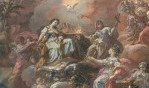
Tiepolo is a brilliant example of the specifically pictorial intelligence. This book is both a study of his art and an argument for fuller recognition of the peculiarities of the painter's representational medium.
Alpers and Baxandall locate distinctive modes of Tiepolo's representation of the world and human action ; follow his process of invention from first pen drawings, through small oil sketches, to great frescoes ; and analyse his best and biggest painting, the Four Continents in the Stairwyay Hall of the Prince-Bishop's Residence at Würzburg.